The transaction
building a rental property portfolio: A Decision-First Guide
A purchase is a sequence of checks, not a single decision. Knowing the order matters, because the money and the commitment enter at different stages.
building a rental property portfolio is a starting point for property due diligence; the correct answer depends on documents, jurisdiction, financing, and the exact transaction.
The practical objective of the building / rental / portfolio review is to understand the property decision without treating a general article as legal, tax, lending, or investment advice. Keep ownership rights, written terms, cash flow, local rules, and exit constraints visible throughout the decision.
Keep building a rental property portfolio anchored to the building / rental / portfolio review. In property decisions, the signed document and applicable law matter more than an informal label. Separate durable principles from claims that can become outdated or differ across situations.
What the property term changes in practice
Start by defining the decision in plain language. Under the building / rental / portfolio review lens, a definition is useful only when it changes what the reader checks, compares, writes, or asks next. Preserve qualifiers such as ‘often,’ ‘may,’ or ‘under local rules’ when the available evidence does not justify a universal statement.
Within the building / rental / portfolio review, the focus is ownership rights, written terms, cash flow, local rules, and exit constraints. In property decisions, the signed document and applicable law matter more than an informal label. That combination gives the editor a clear standard for deciding which material belongs and which tempting digressions should be cut.
A property decision illustrated with assumptions
A concrete building / rental / portfolio review scenario clarifies building a rental property portfolio without pretending that one case proves a general rule. Each example below is illustrative and deliberately avoids invented statistics or endorsements.
- Illustrative scenario: a buyer compares two similarly priced properties. One has lower monthly costs, while the other has restrictions that limit rental use. Price alone does not settle the decision.
- Document example: a listing summary is a discovery source; the deed, disclosures, inspection, association records, and lender terms are decision evidence.
The examples are intentionally modest. Their job in a building / rental / portfolio review guide is to demonstrate reasoning, wording, or comparison—not manufacture social proof, clinical certainty, investment performance, or a company's history.
A due-diligence sequence for the transaction
Turn building a rental property portfolio into a documented building / rental / portfolio review workflow with these steps. Each one should produce a note, comparison, question, or decision rather than more open-ended browsing.
1. Define the property, location, parties, and decision date.
Record unknowns openly so an editor does not mistake them for facts. For the building / rental / portfolio review question, keep the result short enough that another person can audit it without reconstructing the whole search.
2. Collect current documents rather than relying on listing language.
Choose a next move proportionate to cost, risk, and reversibility. For the building / rental / portfolio review question, keep the result short enough that another person can audit it without reconstructing the whole search.
3. Separate purchase price from financing, operating costs, reserves, and transaction costs.
Use the closest authoritative source available for consequential claims. For the building / rental / portfolio review question, keep the result short enough that another person can audit it without reconstructing the whole search.
4. Mark every assumption controlled by local law or a negotiated clause.
Set a review point and note what evidence could change the decision. For the building / rental / portfolio review question, keep the result short enough that another person can audit it without reconstructing the whole search.
5. Stress-test one unfavorable but plausible change.
The output is a one-sentence scope that prevents drift. For the building / rental / portfolio review question, keep the result short enough that another person can audit it without reconstructing the whole search.
6. Ask qualified local professionals to review material rights and obligations.
Keep the raw observation or document separate from your interpretation. For the building / rental / portfolio review question, keep the result short enough that another person can audit it without reconstructing the whole search.
Documents and numbers to compare
For building a rental property portfolio, the building / rental / portfolio review should compare like with like and attach a date to changing information. A lower price, shorter distance, stronger headline, or familiar name is not decisive when scope, rights, evidence, or risk differ.
| Review area | Decision question | Evidence or output |
|---|---|---|
| Title | Who owns what, and how is it recorded? | Deed and recorded records |
| Contract | Which deadlines, conditions, and remedies apply? | Signed agreement and addenda |
| Condition | Which defects or maintenance obligations are known? | Inspection and disclosure records |
| Money | Which costs recur or can reset? | Lender terms, bills, and budgets |
| Exit | What could restrict sale, lease, or transfer? | Local rules and governing documents |
Complete one row at a time across all alternatives. That approach reduces the chance that an attractive building / rental / portfolio review option receives detailed positive notes while a less familiar option is described only by its gaps.
Mistakes that weaken the answer
The building / rental / portfolio review failure modes around building a rental property portfolio are predictable: unclear scope, unsupported certainty, and advice that ignores the condition changing the answer. Review these problems:
- Avoid: Assuming a term has the same legal effect everywhere.
- Avoid: Using projected returns without defining every input.
- Avoid: Treating a directory or listing profile as proof of current status.
- Avoid: Ignoring an exit restriction because it does not affect the initial purchase.
The repair is to narrow the claim and show the decision path. In a building / rental / portfolio review draft, replace ‘always,’ ‘best,’ ‘guaranteed,’ or ‘instant’ with the supported condition, the evidence available, and the point at which professional or official review becomes necessary.
Questions readers commonly ask
Can a general definition settle a transaction?
No. Use it to identify the documents and questions that require local, transaction-specific review. In the building / rental / portfolio review, keep that answer tied to the stated scope and evidence.
Which source should carry the most weight?
For rights and obligations, start with executed documents, official records, and current guidance from the relevant authority. In the building / rental / portfolio review, keep that answer tied to the stated scope and evidence.
What must be checked before publication?
For the building / rental / portfolio review, Verify current law, licensing, ownership records, fees, tax treatment, financing terms, and named entities with applicable official or first-party sources. Add direct links and review dates in the editorial system, and remove any assertion that the available evidence does not support.
Editorial and safety boundary
No named person, organization, product, clinic, property, employer, or platform should be endorsed by implication. In the building / rental / portfolio review article, verify identity and current status, distinguish illustrative language from reported fact, and preserve privacy.
For the building / rental / portfolio review decision, confirm executed documents, current public records, and local requirements with appropriately licensed professionals. General examples do not determine ownership rights, taxes, financing, contract remedies, or investment suitability.
Bottom line
A useful page about building a rental property portfolio ends the building / rental / portfolio review with a proportionate decision, not a dramatic promise. Preserve real uncertainty, verify material facts, and make the next action clear enough to complete.
Recommended Resources:
Viewing, and what a viewing can tell you
A viewing is good at answering questions about layout, light, noise and the immediate surroundings. It is poor at answering questions about structure, damp, services and boundaries, because those are either hidden or slow to reveal themselves. Treat the visit as a test of whether the plan works for the household, and leave the building's condition to a later stage.
Visiting twice, at different times of day and week, answers more questions than any single long visit.
The offer
An offer is a proposal, and in most systems it binds nobody. It carries two kinds of information: the figure, and the position of the buyer — whether they have a property to sell, how their purchase is funded, and how quickly they can move. Sellers weigh both, and often weigh the second more heavily than buyers expect.
Once an offer is accepted the property is usually described as under offer or sold subject to contract. Neither phrase means the sale is agreed in any binding sense.
Legal work and enquiries
After acceptance the legal stage begins. It establishes who owns the property, what precisely is being sold, what rights and obligations come with it, and what the public record says about the land and the area around it. This is where searches are carried out and where questions are put to the seller's side.
This stage is where most delay lives, and most of it is waiting for third parties rather than work being done slowly.
Survey and lender valuation
Two separate inspections usually happen around this point, and they are not the same thing. A lender's valuation protects the lender's security. A survey commissioned by the buyer reports on the condition of the building for the buyer's benefit. One is not a substitute for the other.
A survey that identifies work is not a reason to stop; it is information about cost and timing that did not exist before.
Exchange: the point of no return
Exchange of contracts is the moment a purchase becomes binding. Before it, either side can generally walk away and lose only what they have already spent. After it, walking away has serious financial consequences. Everything that needs to be known should be known before this point, not after it.
Completion, and afterwards
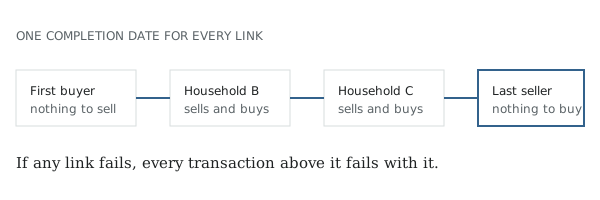
Completion is the transfer of money and possession, usually on a date agreed at exchange. Where the purchase sits in a chain, completion has to be coordinated with every other transaction in it, which is why dates are negotiated as carefully as figures.
After completion the ownership record is updated and any tax on the transaction is dealt with. These are administrative rather than uncertain, but they are not instantaneous.