
What this site covers, and how to read it
Housing is discussed almost entirely in national figures, and almost nobody buys a national average. What a household meets is a market of a few streets, a few dozen suitable homes and a handful of sales a season. That market has its own mechanics, and most of the confusion around housing comes from applying the language of one scale to the other.
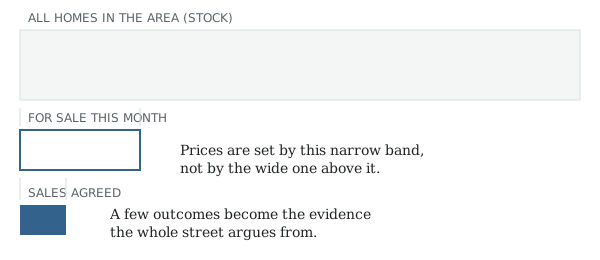
The pages here are organised around three ideas. The first is that a local market is best understood as a large fixed stock of homes with a very small flow of them for sale at any moment. The second is that a transaction is a sequence of checks rather than a single decision, and that the money and the commitment enter at different points in that sequence. The third is that finance sets the ceiling: what buyers can borrow determines what they can bid, so the cost of borrowing runs underneath every other explanation.
This is a writing project, not a business. Nothing here is for sale, no property is listed or valued, and no page offers advice on an individual purchase, loan or legal question. Where a subject requires professional judgement about a specific building or a specific household, the pages say so and stop.
Current reading
More
The subjects, in order
-
How a local housing market works
A market of a few streets is thin: a handful of sales in a season set the reference points everyone else argues from.
-
What actually moves house prices
Borrowing costs, the number of homes for sale, travel time and the condition of the building itself, in roughly that order of force.
-
Buying a home, step by step
From the first offer to the day the keys change hands, and where in that sequence a purchase is still reversible.
-
Selling a home, step by step
How an asking price is set, what marketing actually does, and why the first three weeks decide most sales.
-
Surveys and searches
A valuation, a survey and a search answer three different questions. Confusing them is the most common expensive mistake.
-
Mortgages in plain terms
Capital, interest, term and loan to value, explained without product names, recommendations or rates.
-
Renting versus owning
The real comparison is not monthly cost. It is who carries the maintenance risk and who can move at short notice.
-
Leasehold and freehold
What is actually being bought in each case, and why the difference shows up in the cost of living in a flat.